Why Small Businesses Should Be Careful Comparing Themselves to Giant Brands
One of the biggest mistakes small business owners make is comparing themselves to mature brands without understanding how those brands actually started. People look at companies like Trader Joe's or Costco and assume there must be some magical principle behind their success. Maybe they think the business “doesn’t advertise,” or that the company simply built a great product and customers naturally flooded in. But that interpretation misses the real story, and more importantly, it misses the real lessons that smaller businesses should actually be studying.
Trader Joe’s did not begin as the beloved grocery chain people recognize today. It began as a small convenience store operation called Pronto Markets, founded in 1958 by Joe Coulombe in Southern California. At the time, convenience stores were rapidly growing in popularity, especially as competitors like 7-Eleven expanded aggressively. Coulombe eventually realized something that many business owners struggle to admit to themselves today: he was not going to beat larger competitors by copying them more efficiently. He understood that trying to become a smaller version of a giant company was a losing strategy.
The Pivot That Changed Everything
That realization became the turning point for the entire business.
Instead of competing directly with major convenience chains, Coulombe chose to reposition the company entirely. In 1967, he opened the first Trader Joe’s in Pasadena, but what made the store different was not simply the products on the shelves. The business was built around a very specific idea of who the customer was supposed to be. Coulombe famously described his target customer as “overeducated and underpaid,” meaning people who were intelligent, curious, worldly, budget-conscious, and interested in quality products without luxury pricing. That understanding influenced nearly every decision the company made, from store atmosphere and humor to product selection, pricing strategy, wine offerings, and eventually the heavy emphasis on private-label goods.
This is where small business owners should pay close attention, because the real lesson of Trader Joe’s is not that the company somehow avoided marketing or stumbled into success accidentally. The real lesson is that the business became extremely intentional about positioning. Joe Coulombe did not try to appeal to everyone, and that is precisely why the brand became memorable.
Why Specificity Creates Stronger Businesses
Many small businesses struggle because they stay too broad for too long. They are afraid to narrow their messaging, afraid to specialize, and afraid to define exactly who they serve because they worry it will exclude potential customers. In reality, the opposite usually happens. Broad businesses become forgettable businesses. Trader Joe’s succeeded because the company understood exactly who it wanted to attract, and once that customer identity became clear, decision-making became easier across the board.
That is one of the most transferable lessons from Trader Joe’s early history. Businesses grow faster when they know who they are for. Specificity improves marketing, strengthens referrals, sharpens messaging, and makes it easier for customers to remember what the company actually does.
Trader Joe’s Did Not Avoid Marketing
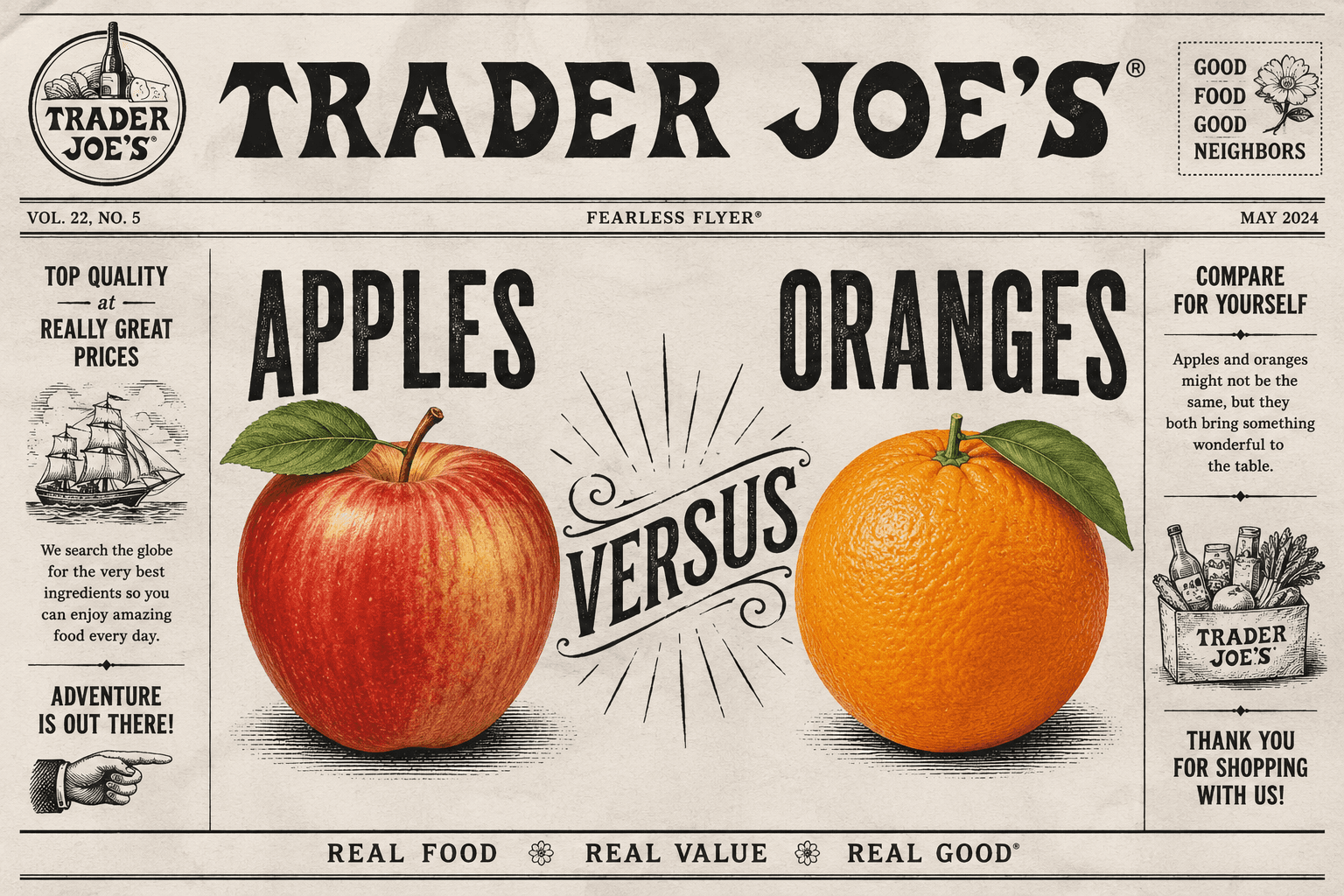
The other myth worth correcting is the idea that Trader Joe’s “didn’t market itself.” That simply is not true. Joe Coulombe used newsletters, radio advertising, branded flyers, and later what became the Fearless Flyer. Today, the company still uses podcasts, recipes, email campaigns, and owned content to reinforce the brand. What Trader Joe’s avoided was not marketing itself; it avoided expensive, generic marketing that did not align with the company’s personality or economics. That distinction matters enormously for small businesses.
A lot of business owners today fall into an unhealthy pattern where they either believe they need massive advertising budgets to compete, or they swing to the opposite extreme and convince themselves that “great businesses don’t need marketing.” Neither position is realistic. Visibility still matters. Repetition still matters. Communication still matters. If people do not know your business exists, they cannot buy from you. What businesses like Trader Joe’s demonstrate is that marketing works best when it feels native to the brand itself rather than disconnected from it.
Operations Are Part of the Brand
There is also an operational lesson hidden inside Trader Joe’s growth that many people completely overlook. The company simplified inventory, leaned heavily into private-label products, streamlined operations, and created systems that reinforced profitability while maintaining a distinct customer experience. In other words, the operational model itself became part of the branding.
Small businesses often separate branding from operations as if they are unrelated topics, but customers experience operations constantly. Slow response times, confusing onboarding, inconsistent communication, and poor delivery systems all shape how customers perceive a company, whether the business realizes it or not.
Good operations create trust. Clear systems create consistency. Consistency creates reputation.
Final Thoughts
Ultimately, the story of Trader Joe’s is not a story about avoiding competition altogether. It is a story about refusing to compete on the wrong terms. Joe Coulombe understood that he could not out-scale giant competitors, so he built something more distinctive instead. That is a far more useful lesson for small business owners than the fantasy that successful companies somehow grew without visibility, promotion, or strategic positioning.
The businesses people admire today were usually built through years of careful decisions, operational refinement, customer understanding, and consistent communication. Trader Joe’s simply happened to do those things exceptionally well.